


Pulse Field Ablation for AFib in Toledo, Ohio: A New Era in Heart Rhythm Care
Atrial fibrillation (AFib, an irregular heart rhythm originating in the upper chambers of the heart) affects millions of Americans, and for patients in Toledo, Northwest Ohio, and the surrounding communities of Maumee, Perrysburg, Sylvania, and Bowling Green, effective treatment options have never been more advanced. Toledo Cardiology Consultants now offers Pulse Field Ablation (PFA), a next-generation electrophysiology treatment for AFib that uses precise electrical pulses rather than heat or freezing to restore normal heart rhythm. If you have been searching for electrophysiology care in Toledo, Ohio, this post explains what PFA is, how it works, and whether it may be right for you.
WHAT IS ATRIAL FIBRILLATION?
AFib occurs when the electrical signals that coordinate the heartbeat become chaotic, causing the atria (the two upper chambers of the heart) to quiver rather than beat in an organized, rhythmic pattern. This disorganized activity prevents blood from moving efficiently through the heart.
Common symptoms include palpitations (a fluttering or racing sensation in the chest), shortness of breath, fatigue, and lightheadedness. Beyond quality of life, AFib carries a clinically significant risk: it can allow blood to pool and clot in the heart, substantially increasing the risk of stroke. For patients whose symptoms persist despite medication, catheter ablation (a procedure in which a thin, flexible tube is guided to the heart to disable the tissue causing abnormal signals) is often the next appropriate step.
To learn more about the full range of AFib treatment options available through our practice, including stroke prevention strategies, visit our detailed overview of atrial fibrillation treatment in Toledo, Ohio.
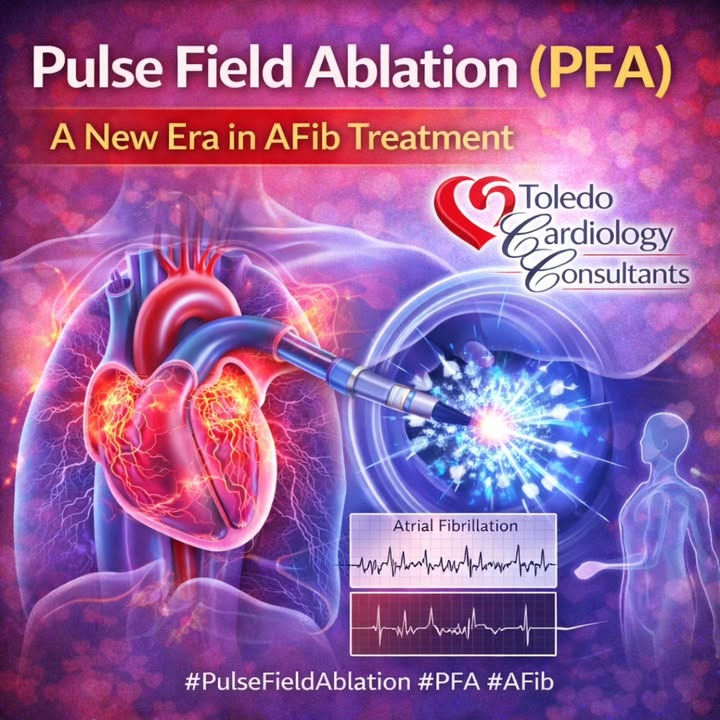
WHAT IS PULSE FIELD ABLATION?
PFA is the newest generation of catheter ablation technology. Where older methods rely on radiofrequency energy (heat) or cryoablation (extreme cold) to destroy abnormal tissue, PFA delivers focused, ultra-short electrical pulses that cause irreversible electroporation (a process in which targeted cell membranes are disrupted, rendering those cells non-functional) in the precise tissue responsible for AFib.
The critical advantage of this mechanism is selectivity. Heart muscle cells are highly sensitive to PFA energy, while nearby structures, including the esophagus (the tube directly behind the heart) and the phrenic nerve (the nerve that controls the diaphragm), are considerably more resistant. This tissue-specific effect is what distinguishes PFA from thermal ablation techniques and is central to its safety profile.
POTENTIAL BENEFITS OF PFA
Highly targeted treatment: PFA selectively affects the heart tissue responsible for generating abnormal electrical signals while minimizing impact on surrounding anatomical structures.
Reduced risk to adjacent tissues: The esophagus, nerves, and pulmonary veins (the vessels whose electrical misfiring most commonly triggers AFib) are better preserved compared to thermal ablation approaches.
Shorter procedure times: The precision of PFA energy delivery can reduce the overall length of the ablation procedure.
Effective rhythm control: PFA targets the same pulmonary vein isolation (electrical disconnection of the veins that most often trigger AFib) achieved by older methods, but through a safer and more efficient mechanism.
Our electrophysiology team at Mercy Health St. Vincent Hospital in Toledo recently completed the 100th PFA procedure at that facility, a milestone that reflects both the clinical demand for this technology and the depth of our team's procedural experience.
WHO MAY BE A CANDIDATE FOR PFA?
PFA may be appropriate for patients who have symptomatic AFib that has not been adequately controlled with antiarrhythmic medications (drugs designed to regulate heart rhythm), and who are otherwise candidates for catheter ablation. Age, the type and duration of AFib, overall cardiac health, and other individual factors all inform this decision.
Our electrophysiology team conducts a thorough evaluation before recommending any ablation approach. For patients who are not ablation candidates or who are primarily focused on stroke prevention, we also offer the Watchman device for AFib in Toledo, Ohio, a structural heart option designed to reduce stroke risk without long-term blood thinners.
If underlying coronary artery disease (blockages in the arteries supplying the heart) is also a concern, our team can address that through the same practice. You can read more about heart stents in Toledo, Ohio for context on how we approach that condition.
ADVANCED RHYTHM CARE, CLOSE TO HOME
Patients from Toledo, Perrysburg, Sylvania, Findlay, and the Southeast Michigan border area should not need to travel to a distant academic center to access this level of care. Toledo Cardiology Consultants brings subspecialty electrophysiology expertise, including PFA, directly to Northwest Ohio. Our physicians combine procedural experience with the kind of individualized attention that large urban systems frequently cannot offer.
Schedule Your Appointment in Toledo
If you or someone you care about is living with AFib that medications have not adequately controlled, contact Toledo Cardiology Consultants to request a heart rhythm evaluation. Our team will review your history, explain your options, and help you determine whether Pulse Field Ablation or another approach is the right fit. New patients are welcome, and our staff is available to assist with insurance questions and paperwork before your visit. Ample parking is available at our Toledo location.


